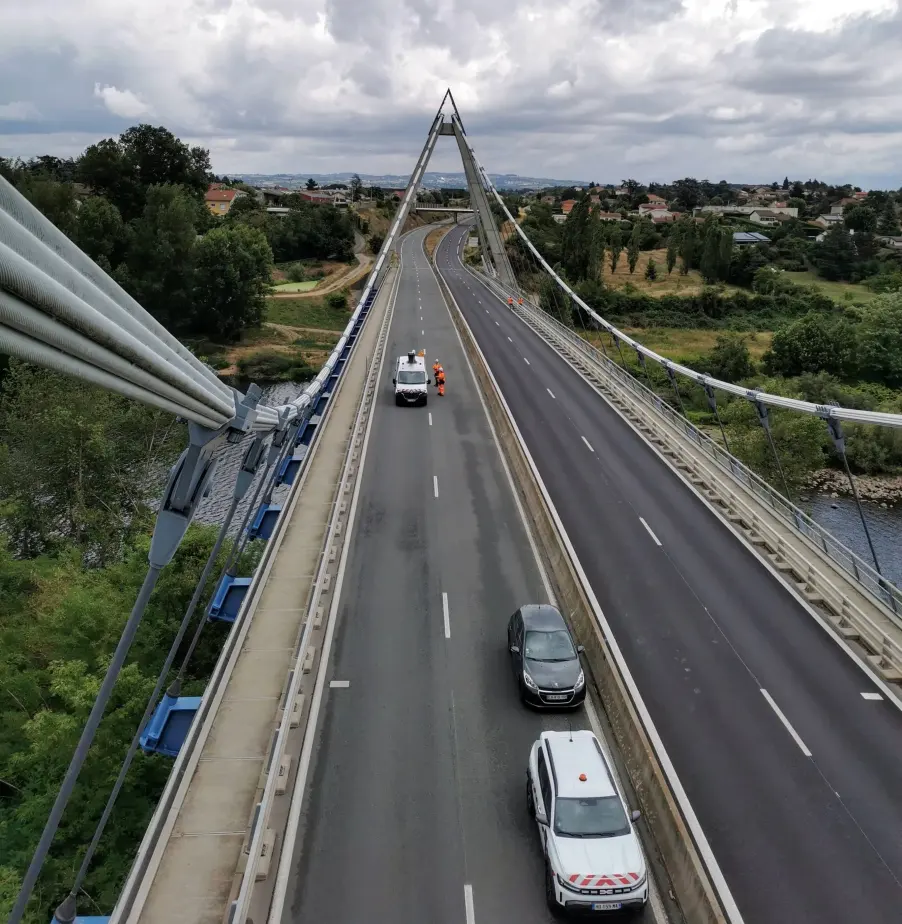
Non-Destructive Testing
Advanced NDT techniques for structural integrity assessment without causing damage
QUAD-S Monitoring employs cutting-edge NDT technologies to provide comprehensive structural assessment services. Our experienced engineers use specialized equipment to evaluate the condition of bridges, buildings, tunnels, and other critical infrastructure without compromising their integrity.
Key Advantages
- Non-invasive inspection without drilling or coring
- Immediate on-site results and analysis
- Cost-effective assessment with minimal disruption
- Applicable to various materials and structures
- Repeatable testing for time-evolution monitoring
- Maintains structural integrity for long-term use
Why Choose Our NDT Services?
Our NDT services provide critical insights into structural condition and integrity:
- Identify internal defects invisible during visual inspections
- Avoid unnecessary dismantling or early replacement
- Effective from inception through entire structure lifecycle
- Repeatable for continuous monitoring over time
- Compliant with international standards (ASTM, EN, ISO)
Applications
Bridges & Viaducts
Bridge hanger inspection, cable thickness measurement, crack detection in concrete decks.
Concrete Structures
Rebar location, cover depth measurement, void and delamination detection in slabs and walls.
Steel Structures
Weld inspection, wall thickness measurement, corrosion and fatigue detection.
Tunnels & Metro
Concrete lining thickness and quality assessment, void detection behind walls.
Historical Heritage
Non-invasive assessment of historical structures requiring maximum preservation.
Our NDT Solutions
QUAD-S Monitoring deploys a comprehensive range of NDT technologies to meet your specific inspection requirements. Our certified engineers perform testing in compliance with international standards, delivering detailed reports and actionable recommendations.
Ultrasonic Testing (UT)
Internal flaw detection, thickness measurement, weld inspection using high-frequency ultrasonic waves.
Ground Penetrating Radar (GPR)
Rebar location, void detection, slab thickness measurement without coring.
Impact-Echo Testing
Delamination, void, and deep crack detection in concrete through acoustic analysis.
Visual Inspection
High-resolution cameras, drones, and borescopes for hard-to-reach areas.
NDT Methods Comparison
| Method | Depth | Resolution | Detects | Access |
|---|---|---|---|---|
| Ultrasonic | Up to 6 m | High | Cracks, thickness | 1 side |
| GPR | Up to 1 m | Medium | Rebar, voids | 1 side |
| Impact-Echo | Up to 1.5 m | Medium | Delaminations, voids | 1 side |
| Visual | Surface | Very high | Surface defects | Direct visual |
Frequently Asked Questions
Do NDT methods damage the structure?
No, that is the very definition of NDT. All our methods are completely non-invasive and cause no damage to the tested structure.
Which NDT method is best for my project?
It depends on what you are looking for. Ultrasonic excels for deep internal defects, GPR for rebar location, and Impact-Echo for delaminations. We often recommend a combined approach.
How long does an NDT inspection take?
It varies by structure size and method. Ultrasonic inspection of a bridge might take 1-3 days, while a quick GPR scan can be done in a few hours.
Are NDT tests compliant with standards?
Yes, all our NDT testing is performed in compliance with applicable ASTM, EN, and ISO standards. Our engineers are certified and our reports meet regulatory requirements.